
When a fire breaks out in a commercial building, the first few minutes can decide the outcome.
Flames and smoke can travel quickly, far beyond where the fire started. Sprinklers and alarms play a big role in keeping people safe.
However, many businesses overlook one of the most effective tools for limiting fire damage: the fire door.
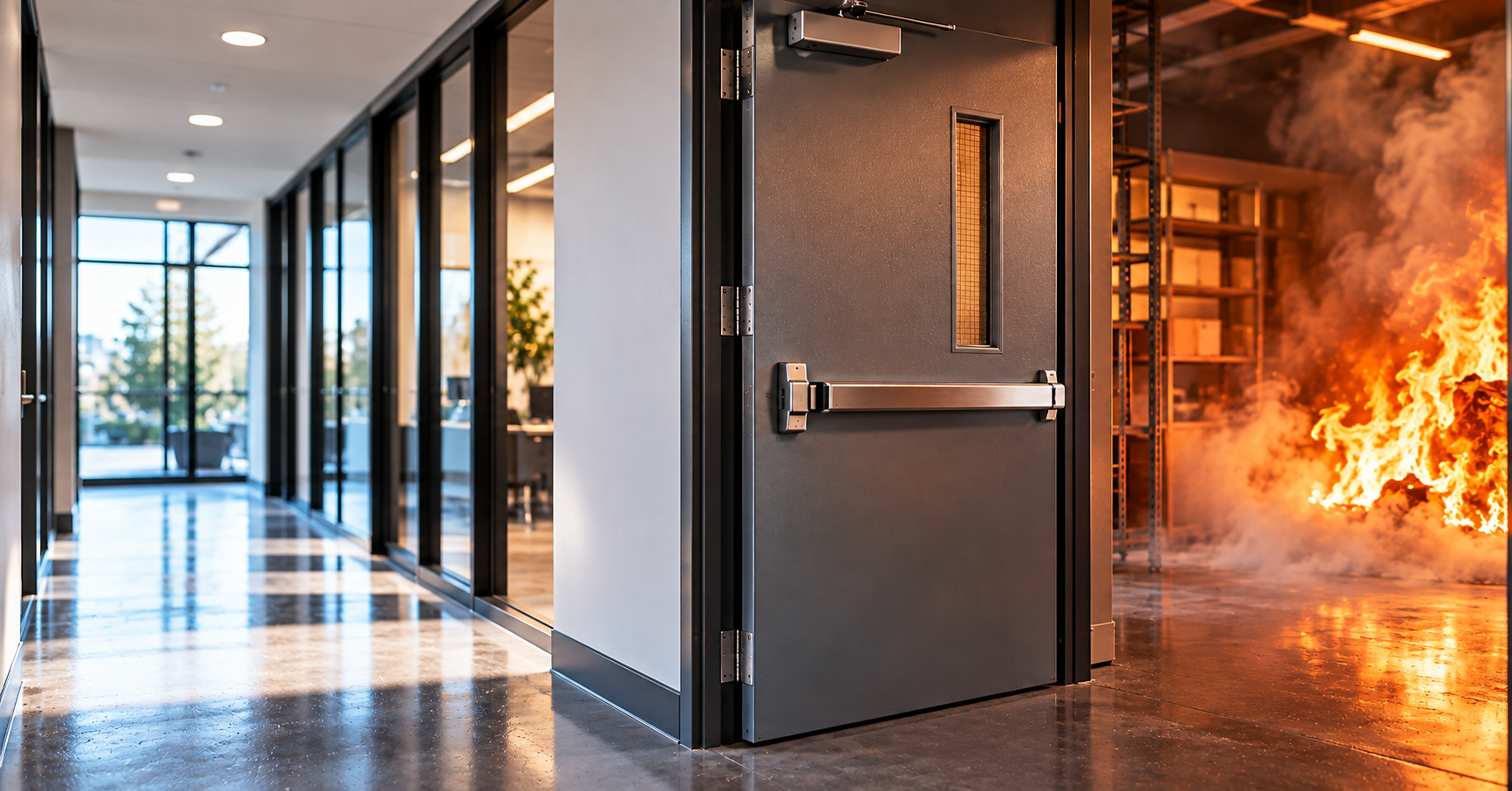
Fire doors are designed to slow the spread of fire and smoke, but they can only do so when closed.
How Fire Doors Protect Your Building
A closed, latched fire door divides a building into fire-resistant sections. Each section holds back flames and smoke, keeping them from reaching the rest of the building. That containment protects hallways and stairwells. It gives everyone inside more time to get out safely. It also helps firefighters do their job. In many cases, closed fire doors greatly reduce property damage along with the time a business spends shut down.
The National Fire Protection Association (NFPA) sets fire door standards. NFPA 80 requires fire doors to stay in good working order, free of anything that blocks them from closing. It also calls for fire door assemblies to be inspected and tested at least once a year. A door that’s propped open can’t do its job. Even a small gap lets smoke and heat move freely into other parts of the building, defeating the whole purpose of the fire-rated barrier.
That’s why every employer should know the risks of open fire doors, plus a few simple habits to prevent them.
The Risks of Open Fire Doors
When fire doors stay open, smoke spreads quickly into nearby spaces. Visibility drops, raising the risk of smoke inhalation for anyone trying to get out. Flames and heat reach areas a closed door would have protected.
Exit routes and stairwells can fill with smoke, cutting off safe ways out of the building. The chance of injuries rises sharply. Firefighters arrive to find a larger fire that’s much harder to control.
The fire also reaches more of the building. Property damage climbs, repairs take longer and reopening gets pushed further out.
What Open Fire Doors Mean for Your Insurance
From an insurance perspective, a propped-open fire door can turn a contained fire into a major claim. Damage spreads further, repairs cost more and downtime stretches longer. Business interruption losses can grow quickly. Keeping fire doors closed protects your people, your property and your ability to stay open. It also shows insurers your business takes risk management seriously.
Why Fire Doors End Up Open
Employees rarely prop a fire door open to create a hazard. In most cases, everyday pressures are to blame.
Comfort is a common reason. In spaces with poor airflow or uneven heating and cooling, an open door can feel like an easy fix. Convenience is another. When people move carts, pallets and equipment through a doorway all day, propping the door open saves time. Some employees see a closed fire door as a nuisance that slows down routine tasks.
Many workers simply don’t know what fire doors do. Without that understanding, it’s easy to underestimate the danger of leaving one open. Broken equipment plays a part too. A damaged or worn self-closing mechanism may keep a door from shutting properly. Instead of reporting the problem, employees often just leave the door open.
Best Practices for Fire Door Safety
Fire doors work best with consistent use, regular maintenance and clear expectations for everyone in the workplace. A few simple habits can reduce fire risk, support code compliance and limit the size of a loss.
- Keep fire doors closed. Never prop a fire door open. The only exception is a door with an approved automatic hold-open device. These devices release the door when a fire alarm sounds, letting it close on its own.
- Make sure doors close fully. Every fire door should close all the way and latch with nothing in its path. A door that doesn’t latch can’t hold back fire and smoke.
- Inspect fire doors regularly. Check doors and their hardware according to NFPA standards, at least once a year. Look for damage, missing parts and anything that could keep a door from working.
- Repair problems right away. Fix damaged hinges, closers, seals and latches promptly. Small problems can weaken a door’s fire rating.
- Train your team. Help employees understand why fire doors matter. When people know how a closed door protects them, they’re far more likely to keep it shut.
- Post clear signs. Simple, visible signs remind everyone to keep fire doors closed.
- Add fire doors to your safety checks. Include fire doors in routine safety audits and facility inspections. Regular checks build accountability and keep your building in compliance.
A Simple Step With a Big Payoff
Keeping fire doors closed costs nothing. It’s one of the most effective ways to protect your people, your building and your business. When used as designed, fire doors save lives, limit damage and help you get back to work faster. When they’re propped open or neglected, a small fire can become a serious, costly loss.
Have questions about your property coverage or risk management? Contact Murphy Insurance Agency or call us at 800-222-8711. We’re always happy to help.
https://www.dfmurphy.com/wp-content/uploads/The-Importance-of-Keeping-Fire-Doors-Closed-Graphic.png
907
1734
Wayne Texeira
https://dfmurphy.wpenginepowered.com/wp-content/uploads/Murphy-Insurance-Logo-Header.jpg
Wayne Texeira2026-11-02 07:00:402026-10-29 19:01:01The Importance of Keeping Fire Doors Closed https://www.dfmurphy.com/wp-content/uploads/The-Role-of-Umbrella-and-Excess-Liability-Coverage-in-Protecting-Against-Nuclear-Verdicts.jpg
628
1200
Murphy Insurance
https://dfmurphy.wpenginepowered.com/wp-content/uploads/Murphy-Insurance-Logo-Header.jpg
Murphy Insurance2026-10-27 07:00:292026-10-29 11:44:40How Umbrella Insurance Protects Your Business From Nuclear Verdicts
 https://www.dfmurphy.com/wp-content/uploads/5-Common-Insurance-Mistakes-Small-Businesses-Make-.jpg
628
1200
Murphy Insurance
https://dfmurphy.wpenginepowered.com/wp-content/uploads/Murphy-Insurance-Logo-Header.jpg
Murphy Insurance2026-10-06 12:51:292026-10-06 16:02:595 Common Insurance Mistakes Small Businesses Make
 https://www.dfmurphy.com/wp-content/uploads/Addressing-5-Common-Sources-of-General-Liability-Claims.png
907
1734
Wayne Texeira
https://dfmurphy.wpenginepowered.com/wp-content/uploads/Murphy-Insurance-Logo-Header.jpg
Wayne Texeira2026-09-30 07:00:482026-09-28 13:20:16Addressing 5 Common Sources of General Liability Claims
 https://www.dfmurphy.com/wp-content/uploads/How-AI-Is-Changing-Cyber-Insurance-1200.jpg
628
1200
Wayne Texeira
https://dfmurphy.wpenginepowered.com/wp-content/uploads/Murphy-Insurance-Logo-Header.jpg
Wayne Texeira2026-09-15 07:00:112026-09-17 12:12:48How AI Is Changing Cyber Insurance
 https://www.dfmurphy.com/wp-content/uploads/Evan-Macedo-1200-x-628-.jpg
628
1200
Wayne Texeira
https://dfmurphy.wpenginepowered.com/wp-content/uploads/Murphy-Insurance-Logo-Header.jpg
Wayne Texeira2026-09-09 11:19:362026-09-10 15:39:23Murphy Insurance Welcomes Evan Macedo to Our Leadership Team
 https://www.dfmurphy.com/wp-content/uploads/The-Value-of-Using-a-Virtual-Private-Network.jpg
628
1200
Wayne Texeira
https://dfmurphy.wpenginepowered.com/wp-content/uploads/Murphy-Insurance-Logo-Header.jpg
Wayne Texeira2026-09-01 21:08:272026-09-01 21:18:39The Value of Using a Virtual Private Network
 https://www.dfmurphy.com/wp-content/uploads/Password-Management-Best-Practices.jpg
628
1200
Wayne Texeira
https://dfmurphy.wpenginepowered.com/wp-content/uploads/Murphy-Insurance-Logo-Header.jpg
Wayne Texeira2026-08-20 07:00:052026-08-13 18:55:41Cybersecurity Essentials | Password Management Best Practices
 https://www.dfmurphy.com/wp-content/uploads/Man-looking-through-folder-scaled.jpg
1340
2560
Murphy Insurance
https://dfmurphy.wpenginepowered.com/wp-content/uploads/Murphy-Insurance-Logo-Header.jpg
Murphy Insurance2026-08-10 07:00:312026-06-26 15:01:52The Time Is Now to Kick-start Open Enrollment Efforts
Visit Our Business Insurance Page

Murphy Insurance stands as your steadfast partner in safeguarding your business from unforeseen challenges in today’s dynamic business landscape. In an era where comprehensive business insurance is not just a prudent choice but a vital one for ensuring the long-term stability and security of your enterprise, we are here to offer our expertise. Running a business inherently entails various risks that can potentially impact your financial stability and reputation. Learn more about our comprehensive business insurance solutions, which are meticulously designed to protect you from these potential threats, granting you peace of mind necessary to focus on the growth and prosperity of your business.
